Storytelling for Kids: 12 Easy Tips That Really Work
The best way to do storytelling for kids is to keep stories short, use different voices and facial expressions, add simple props, repeat key phrases, and ask open-ended questions. For toddlers, aim for 2 to 5 minutes, use familiar characters, and invite your child to join in with sounds and actions.
You don’t need to be a natural performer. If you can read a picture book aloud, you can tell a story a child will remember. This guide gives you 12 practical tips, plus age-wise advice and a ready-to-use story for toddlers. For more everyday ideas, browse our parenting tips.
What is storytelling for kids?
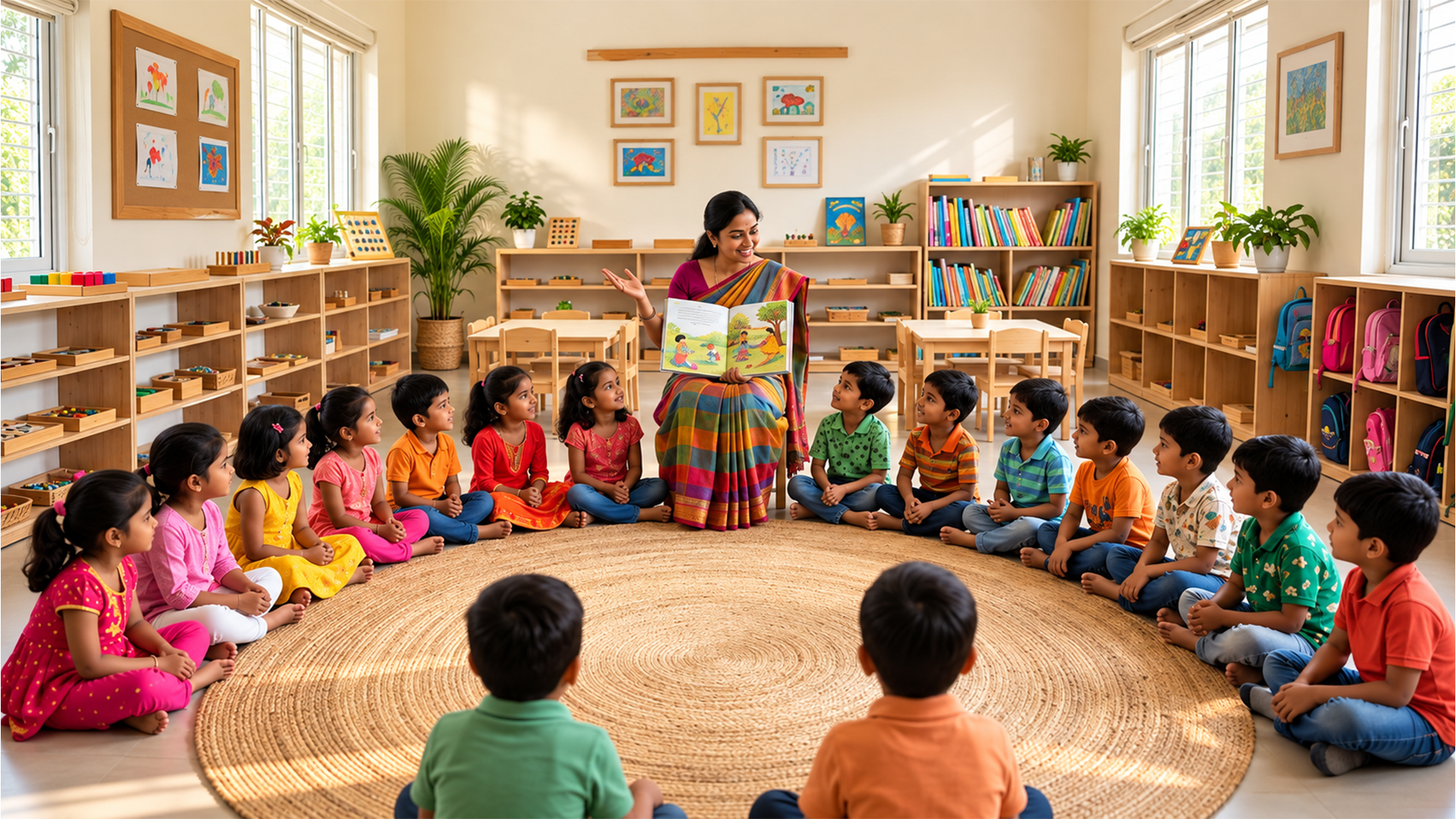
Storytelling for kids means sharing a story aloud, from a book or from your own imagination, in a way that holds a child’s attention. It combines voice, expressions, gestures, and interaction. The aim is to help children listen, imagine, and connect with the story, not just hear words.
Why storytelling matters for young children
Storytelling is one of the easiest daily habits to build, and it supports several areas of early development:
Pediatric bodies such as the American Academy of Pediatrics encourage reading aloud with children from infancy, and storytelling builds on the same benefits.
How long should stories for toddlers be?
| Age | Ideal length | What works best |
|---|---|---|
| 12 to 18 months | 1 to 2 minutes | Board books, animal sounds, single-word repetition |
| 18 to 24 months | 2 to 3 minutes | Familiar objects, simple actions, repeated phrases |
| 2 to 3 years | 3 to 5 minutes | Simple plots, favourite characters, actions, and songs |
| 3 to 5 years | 5 to 10 minutes | Short moral tales, “what happens next?” questions |
These ranges are guidelines. If your child walks away, shorten the story rather than forcing it. If your child is nearing preschool age, our early learning programs are designed for this stage of development.
12 easy storytelling tips for kids
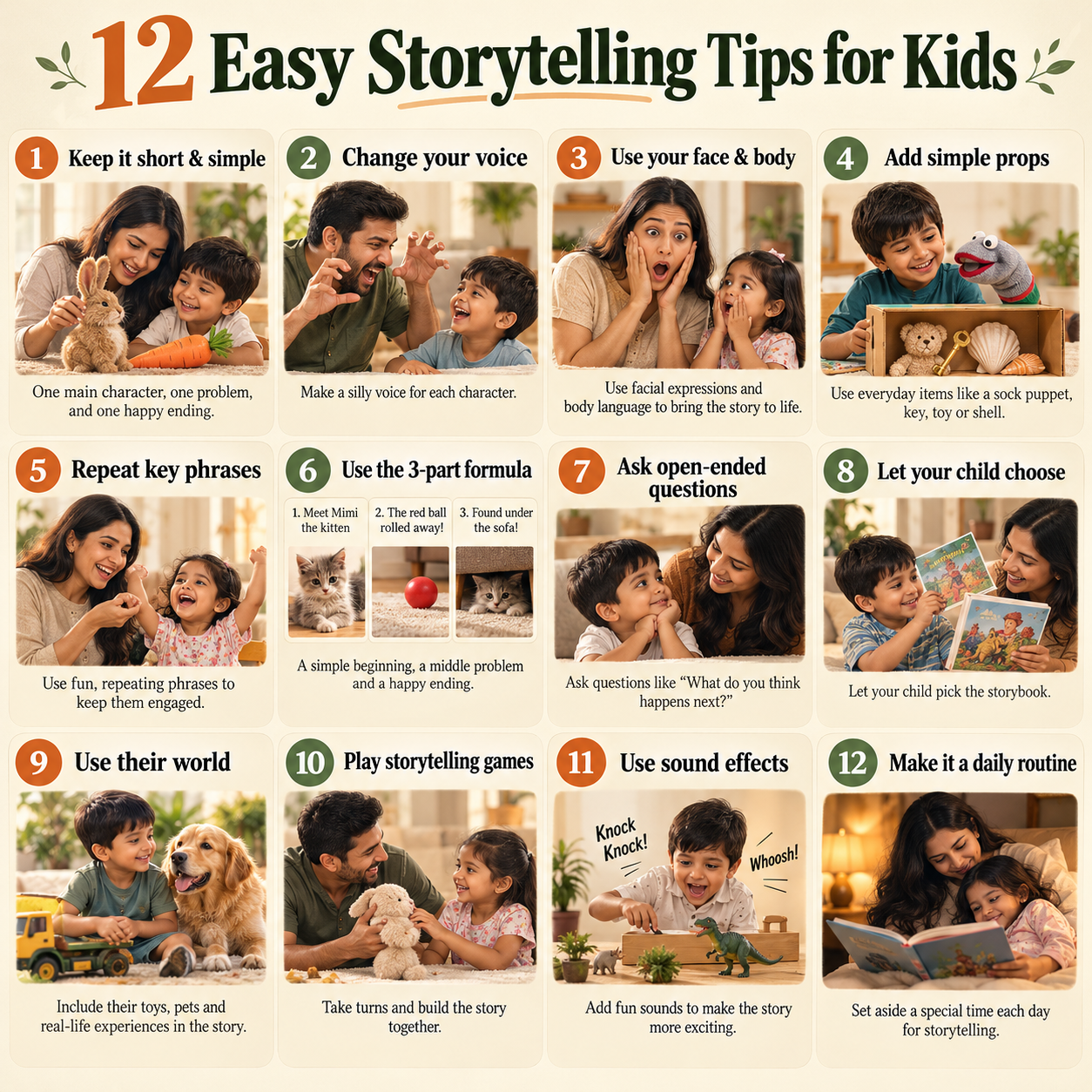
1. Keep it short and simple
Use one main character, one problem, and one happy ending. Short sentences work best for toddlers.
“Little Bunny was hungry. Hop, hop, hop! He found a carrot. Crunch, crunch. Yum!”
2. Change your voice for each character
A deep voice for the bear and a squeaky voice for the mouse help children tell characters apart and keep listening. It doesn’t need to be perfect.
3. Use your face and body
Widen your eyes for surprise, whisper for secrets, and slow down for suspense. Toddlers read faces before they follow words.
4. Add simple props
A soft toy, a scarf, or a spoon can become the whole cast. A story box (a small box of 4 to 5 everyday objects) lets your child pick items that become part of tonight’s tale.
5. Repeat key phrases
Toddlers love repetition. A refrain like “Hop, hop, hop!” or “And off they went!” lets them predict and join in, which builds language.
6. Use the 3-part story formula
Children follow stories more easily when they have a clear shape:
- 1 Beginning: meet the character (“Mimi the kitten loved her red ball.”)
- 2 Middle: something goes wrong (“The ball rolled away!”)
- 3 End: it gets solved (“Mimi found it under the sofa.”)
7. Ask open-ended questions
Pause and ask things like “What do you think Bunny will do?” or “How is the kitten feeling?” Open-ended questions get more than a yes or no, and they show you what your child understands.
8. Let your child choose the story
Offer two options and let them pick. Children who choose are more invested. A shelf of age-appropriate reading books makes this easy. Older kids can also pick the hero’s name or where the story takes place.
9. Use their world
Put your child’s toys, pets, grandparents, or favourite foods into the story. A tale about “Aarav and the runaway chapati” will always beat a generic one.
10. Play storytelling games
Games turn listening into learning through play. Try these:
Pass-the-story:
each person adds one sentence.
What happens next?
Stop at a cliffhanger and let your child decide.
Silly swap:
change one detail (“The cow said meow!”) and let your child correct you.
Picture walk:
tell a story only from the pictures in a book.
For quiet-time follow-up, pair story time with simple activity books so your child can draw or colour a favourite scene.
11. Use sound effects and pauses
Knock on the table for footsteps, whoosh for wind, and pause before the big reveal. Silence builds anticipation.
12. Make it a daily routine
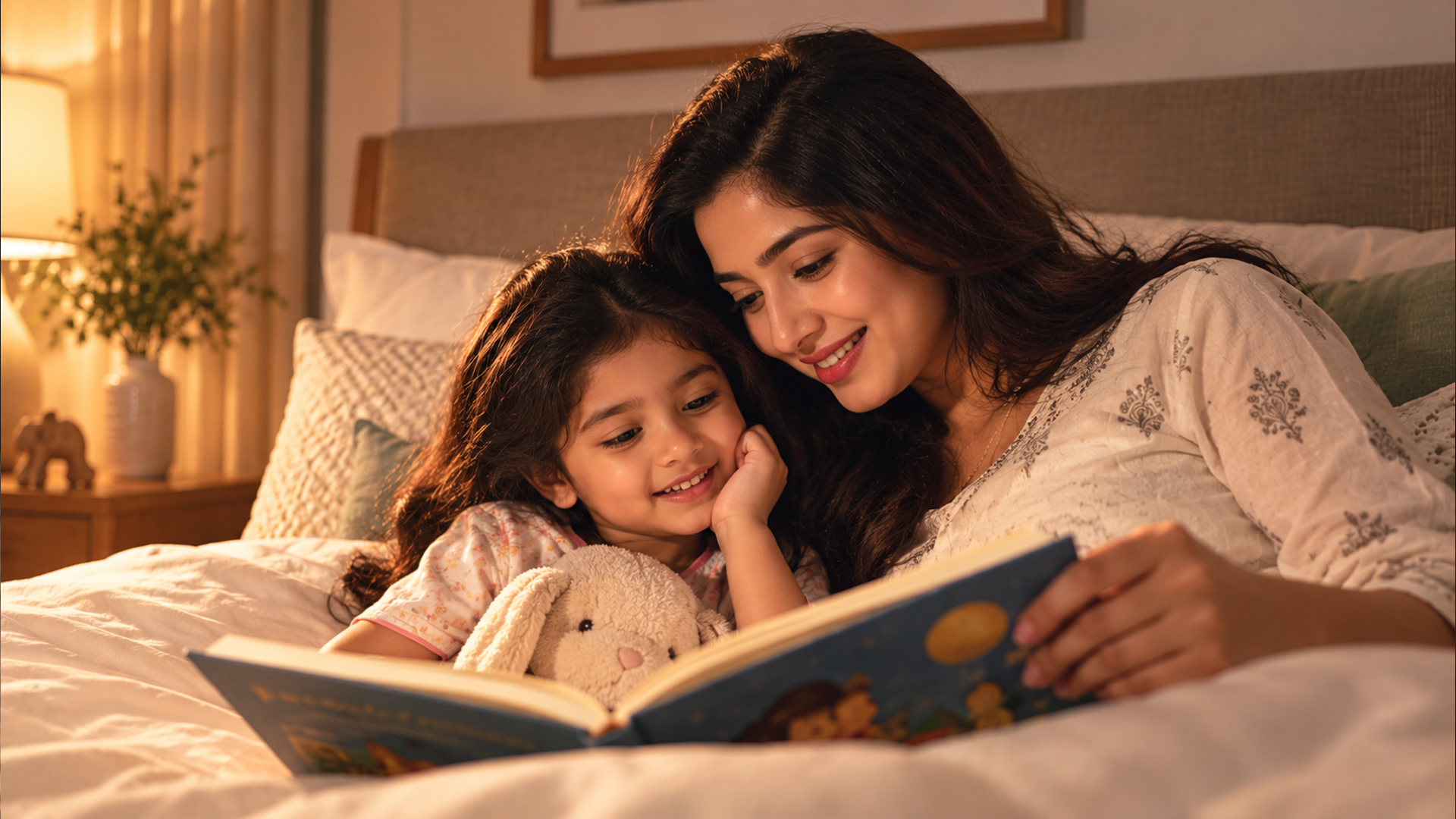
Five minutes at bedtime or after lunch is enough. A regular routine helps children feel calm and builds the listening habit. Practising stories in daily life, such as in front of a mirror or with family, also helps children become confident storytellers themselves.
A 60-second story for toddlers (try it tonight)
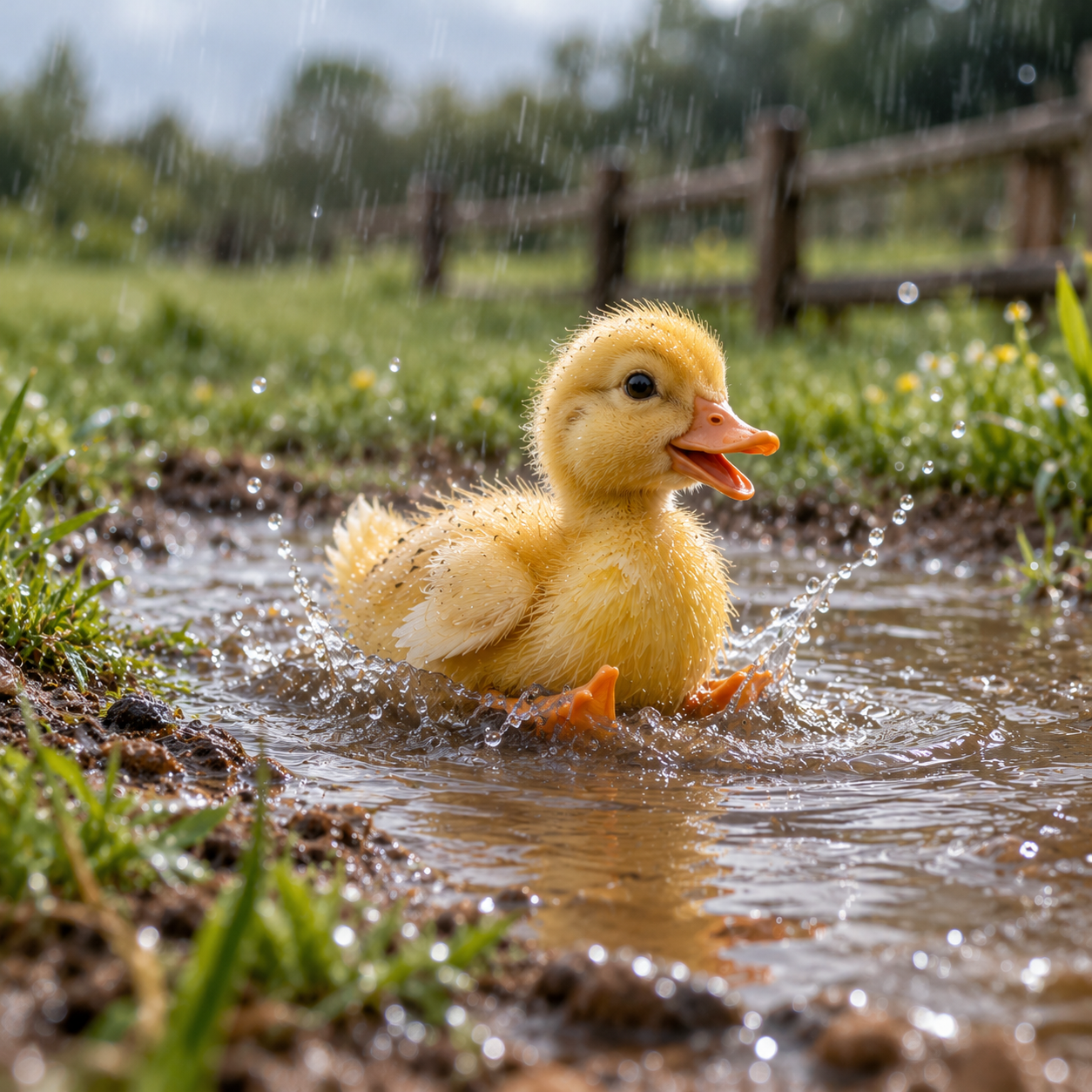
Title: “Little Duck’s Puddle”
(Pause after each line so your child can join in.)
Little Duck woke up. Quack, quack!
It had rained all night. Pitter-patter, pitter-patter!
Little Duck saw a big, big puddle. “Splash?” she asked.
She jumped in. SPLASH!
Water went up. Water went down. Splash, splash, splash!
Little Duck was wet and happy. Quack, quack!
Then she went home for a nice, warm sleep. Shhh... goodnight, Little Duck.
it has one character, a repeated sound, a clear action, and a calm ending that suits bedtime.
Common storytelling mistakes to avoid
Storytelling for kids in 2026: what’s new
Audio stories are popular for car rides and quiet time. They’re useful, but they work best alongside live storytelling, where your child can see your face and respond.
Bilingual storytelling is easy to try at home. Share a story in your mother tongue and in English to build vocabulary in both.
Traditional tales like the Panchatantra and Jataka stories offer short, animal-based stories with clear lessons.
Festive stories are useful around Diwali, Children’s Day (14 November), and winter holidays. They link learning to celebrations your child already enjoys.
Frequently asked questions
At what age should I start telling stories to my child?
You can start from birth. Babies learn from the rhythm and tone of your voice long before they understand words. Simple songs and picture books work well in the first year.
How long should a story for a toddler be?
Most toddlers do best with stories of 2 to 5 minutes. Watch your child’s cues and stop when they lose interest.
What are the best stories for toddlers?
Choose stories with simple plots, familiar animals or objects, repeated phrases, and a calm, happy ending. Board books, nursery rhymes, and short animal tales are all good choices.
How can I make storytelling more engaging?
Use different voices, expressive faces, props, and sound effects. Ask questions during the story and let your child join in with actions.
What if my child gets bored or walks away?
That’s normal at this age. Shorten the story, add a prop or sound effect, or try again later. Don’t force it.
Should I read from a book or make up stories?
Both help. Books build vocabulary and an interest in reading, while made-up stories build imagination and let you use your child’s own world.
How can storytelling help my child’s speech?
Hearing varied words, repeating phrases, and answering questions all give children practice with language. If you have concerns about your child’s speech development, talk to your paediatrician or a speech-language therapist.
Final thoughts
Great storytelling for kids doesn’t need special skills, only a little time, some expression, and plenty of repetition. Start with one tip tonight, such as a repeated sound or a story box, and add more as your child’s interest grows. A few minutes of story time each day can become your child’s favourite part of the day.
If you’re also thinking about your child’s next step in early learning, read our guide to choosing the right preschool in Whitefield, or find more articles on our blog.
Experience Storytelling & Montessori at Linden
From dedicated reading corners and well-equipped libraries to Friday book issuances and creative Circle Time, discover how Linden Montessori nurtures young imaginations in Whitefield, Bangalore.
Schedule a personalized campus tour today to see our learning spaces and library firsthand.